How does LASIK work?
LASIK is a laser eye surgery that may give you the freedom to live without the constraints of contacts and eyeglasses. If you’re one of the 140 million Americans who have a refractive disorder such as nearsightedness (myopia), farsightedness (hyperopia) or astigmatism, LASIK may offer you the vision you have been looking for. At Wolfe Eye Clinic, our highly referred-to LASIK surgeons provide you with more LASIK experience in Iowa than any other provider in the state and our specialty teams are there for you every step of the way.
Is LASIK Right For You?
Take our LASIK quiz to see if you qualify:
Click To Take The Quiz!
LASIK laser eye surgery works by permanently reshaping your cornea, which is the part of your eye that refracts light and helps you see clearly. Wolfe Eye Clinic owns and uses only the most advanced all-laser LASIK surgical equipment to provide the best possible vision outcome, with the least discomfort and the fastest healing possible. LASIK is generally considered safe for the right candidates. As with any surgery, there are risks and the procedure is not for everyone. Patients with thin corneas, cataracts, or severe dry eyes may be unable to move forward with LASIK. Fortunately, new technologies from our Wolfe Eye Clinic specialists may provide an alternative to LASIK such as PRK or an implantable collamer lens (ICL) for patients who are not good candidates for LASIK. All options are discussed at your free LASIK consultation with your LASIK surgeon who can help you weigh the pros and cons of each option.
Watch our video that explains how LASIK works!
Why choose Wolfe Eye Clinic for LASIK?
LASIK Experience and Subspecialty Training
LASIK eye surgery is a surgical procedure, which should not be taken lightly, yet there are many facilities that offer LASIK– so why choose Wolfe Eye Clinic for LASIK in Iowa? In one word, experience. Experience should be one of the most important things to consider before having LASIK. The physicians at Wolfe Eye Clinic are eye specialists including fellowship-trained ophthalmologists who manage complex medical and surgical eye care needs. We know eyes, inside and out, which is why Wolfe Eye Clinic offers the best physicians for LASIK eye surgery in Iowa.
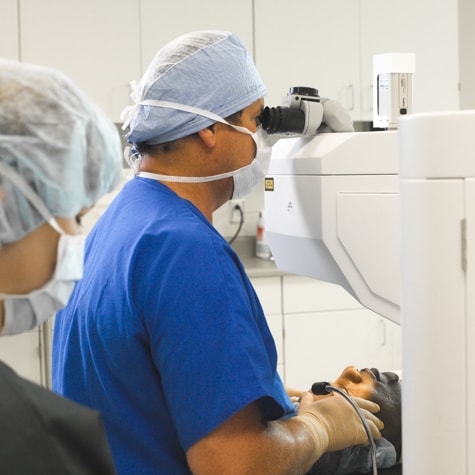
Continuing Wolfe Eye Clinic’s long history of advancing eye care in Iowa, our physicians have been leaders in LASIK and vision correction surgery for decades. They were instrumental in the development of laser vision correction having participated in FDA trials for the excimer laser before it was approved in 1994 and were the first in Iowa to perform LASIK using this technology. In 2006, Wolfe Eye Clinic expanded Iowa’s vision correction options for patients who did not qualify for LASIK by being the first in the state to place an implantable collamer lens (ICL). Historically, Iowans that had astigmatism were not a candidate for ICL. That changed in 2019 when Wolfe Eye Clinic was again the first in the state to place an ICL that specifically corrects for astigmatism known as a toric ICL. With some of the most recent advancements in vision correction surgery, Wolfe Eye Clinic has the experience patients can be confident in. To date, Wolfe Eye Clinic doctors have performed nearly 50,000 LASIK surgeries in Iowa, more than any other provider in the state.
Published in medical journals and textbooks, Wolfe Eye Clinic surgeons have helped educate many other physicians in the field of LASIK laser vision correction and, many of our LASIK doctors have special fellowship training, meaning they performed additional training for LASIK surgery following the standard required years of training needed to practice ophthalmology.
All-laser LASIK technology in Iowa
Unlike other providers, Wolfe Eye Clinic uses the best equipment available for all patients with no additional or hidden fees. Wolfe Eye Clinic owns the Alcon Wavelight® Refractive Suite which offers the most accurate and fastest total LASIK laser eye surgery procedure in the United States. Some other providers forego laser precision by using a mechanical keratome which is a handheld device featuring an oscillating metal blade. Wolfe Eye Clinic surgeons have used all laser LASIK since 2002. Continuously updated ever since, our refractive surgery suite utilizes bladeless, all-laser technology to provide you with the custom LASIK treatment you deserve. Using your own individual eye measurements and the Alcon Wavelight® Refractive Suite, our surgeons can help ensure precision and reduce surgical risks that were previously associated with making corneal flaps with the outdated mechanical microkeratome method.
 We always recommend and provide the best treatment for you. We will not offer you a “menu” of treatment, choices at various price ranges, or a procedure utilizing equipment and supplies that are lower cost to us. After your pre-surgical data is obtained and reviewed during your LASIK consultation, our surgeons are here to answer all your questions and to identify the procedure that will offer you the most accurate results. We will not settle for anything less than the best for you!
Meet With Your Iowa LASIK Surgeon
Many national LASIK chains do not have ophthalmic surgeons on site every day, meaning you may not even meet your surgeon until the day of your procedure. In fact, the surgeon may fly in only a few days a month to perform surgeries. This means that the surgeon may not be present at your pre-surgical LASIK consultation when your surgical data is being obtained and reviewed and may not be available in the hours or days following your procedure to address any questions. At Wolfe Eye Clinic, you meet with your surgeon at your LASIK consultation and have a team of LASIK experts providing the best care in the state for you, every step of the way.
To find out if you are a candidate for LASIK, please call one of our LASIK Coordinators at (833) 532-8809 or click here to schedule a free LASIK consultation near you. Wolfe Eye Clinic has experienced LASIK surgeons across the state and we offer free LASIK consultations in Iowa at our Ames, Ankeny, Cedar Falls, Cedar Rapids (Hiawatha), Des Moines, Fort Dodge, Iowa City, Marshalltown, Ottumwa, Pleasant Hill and Waterloo clinics.